Wednesday, March 20, 2013

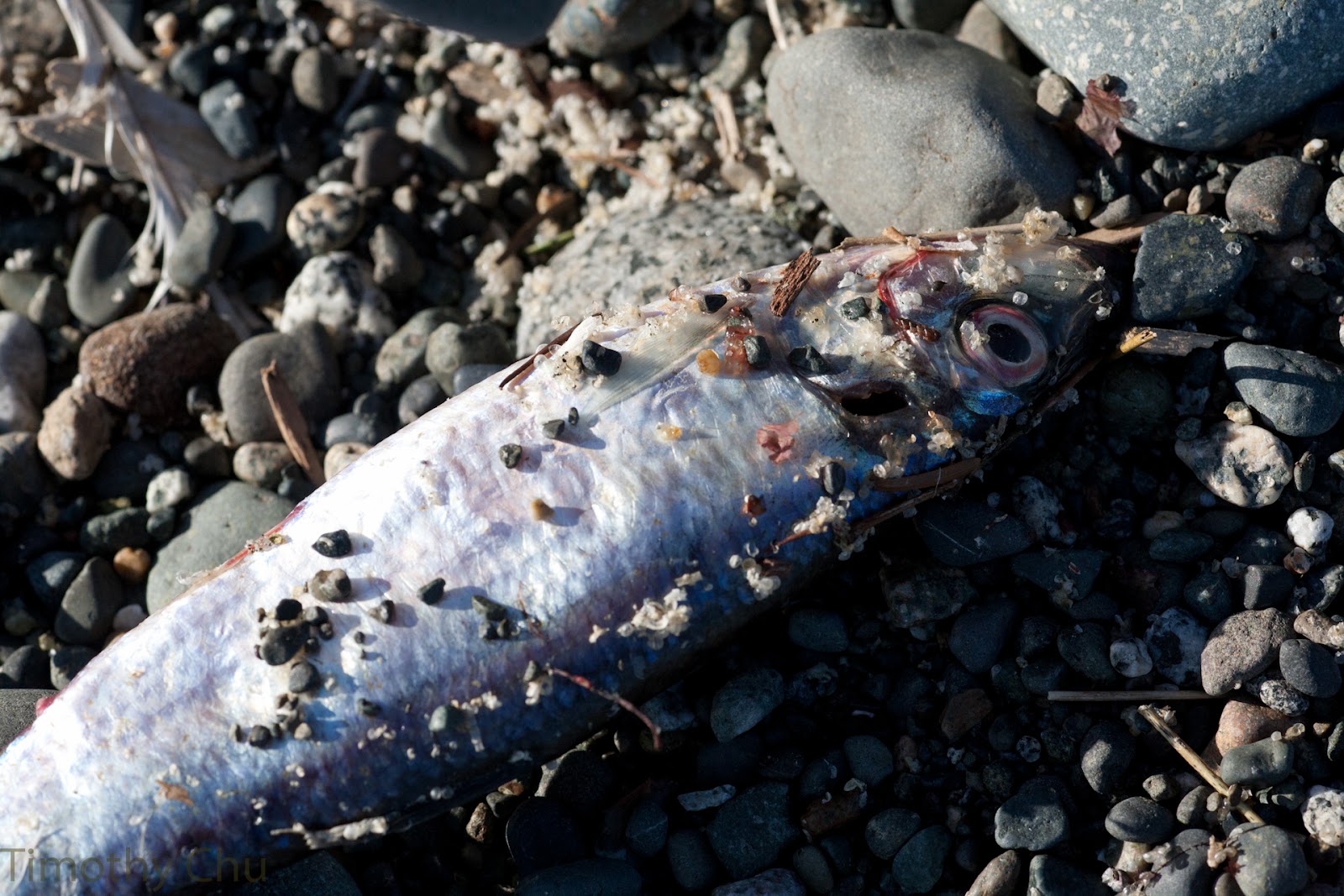
Herring - the signal for the start of spring

A dozen or years ago, I watched the Planet Earth series for the first time.  I watched the entire series with enthusiasm, as it introduced me to groundbreaking form of wildlife cinematography. Each animal story was framed inside its ecology, to illustrate beautifully the food web.


Each episode of the series would focus on specific biomes, and one of those was Cold Waters, referring mostly to waters in the Pacific Northwest.  It described one of the natural wonders of the BC coast - the return of the herring to the beaches where they were hatched. 

Yellow brick road
For a few days, timed with a high tide, herring will proceed to spawn in the intertidal beaches.  The eggs are intended to stick on smooth surfaces like bladderwort and kelp, but billions upon billions of eggs will float away with the pounding surf and coat the beaches.  About a week later, those that survive desiccation and predation they will hatch during a high tide.  The congregation of fish does not go unnoticed, and sea lions, orcas, and sea birds will all gorge themselves on the buffet.  It is the sheer number of spawning herring that ultimately gives their next generation a fighting chance.
Peering out at the world with well developed eyes

A minute-old hatched herring next to two eggs

Tide pools are filled centimetres-deep with herring roe.  In this photo, maybe one egg might reach maturity.

We missed the actual spawn by a few days - we were told that orcas and hundreds of sea lions passed through the week before to follow the herring.

The males employ a shotgun approach at fertilization, ejecting milt (sperm) into the water after a female has laid her eggs, turning the water an aquamarine colour.

Herring roe is traditionally used by native first nations as a food source, and I wanted to try it - I picked up a clump, and bit in.  The salty crunch is no different from the Tobiko used in sushi.
Thursday, January 17, 2013

Still waiting for a hoot

For the second time in my life, I got a good look at owls.  I think I might make this an annual pilgramage, given the abundant birding that's available at Boundary Bay Regional Park.  Last year, I got a good look at some snowy owls and I wanted return with some recently acquired camera gear to get some better shots. I first starting hearing about the snowy owls in December, so I expected they'd still be around this past weekend, but alas, they had already moved on. Despite their absence, and an overcast sky, the air was buzzing with raptors of all sorts.

The road to Boundary Bay Regional Park is lined with telephone poles on one side, and trees on the other.  Just like last year, eagles perched on either side of the road watching the traffic.  The drive in is good preparation for the activity that awaits in Boundary Bay itself.

Owl chasing another raptor
One didn't need to walk far along the dyke before noticing that birds of prey were everywhere.  As pedestrians strolled northwards from the parking lot, owls and hawks pulled aerial stunts, divebombing each other, and chasing would-be competitors off their best hunting grounds.
Short eared owl launching itself off a perch
The dyke divides a wide tidal marsh from farmland.  Last year, it was the tidal side where most photographers aimed their instruments, where the snowy owls sat still on driftwood.  On this visit, most of the activity was witnessed on the farmland, where owls and hawks terrorized voles and other small rodents from manmade perches.

Squawk!
 Just like the snowy owls, the short-eared emit a squawk rather than a hoot.

This short eared landed not 10 metres away, squawking periodically for about 10 minutes.  On the ground, they're nearly invisible:


An owl's success at catching prey doesn't go unnoticed. Typically, it would fly off to a more private location, prey in talons, before swallowing it whole away from its competition.  This trip tends to be a stressful one, as other owls give chase to attempt stealing its freshly caught prey.
The owl dance
Despite my initial intention of getting a second view of the snowy owls, the activity of the short-eared owls definitely made for a more exciting visit to Boundary Bay.

Saturday, December 1, 2012

Its shy side


The Christmas Cactus revealed just a scant group of leaves this year. In the last two years, perhaps only two scrawny leaves have been appended to its stalks. Maybe it doesn't like the bright southern exposure we've given it for the last few years.  This photo was from last weekend, which puts the timing of the opening of the first flowers about two weeks earlier than last year, and a week earlier than two years ago.

The flowers seemed to favour the sunny side.  This angle is the same angle I've photographed it compared to prior years, yet this time, the blooms are nearly all on the opposite side.

The blooms aren't as extravagant as in prior years despite better living conditions than in prior years:  a bit of fertilization in the spring, no pests, and no flooding.
2011
2010
2009


Thursday, September 13, 2012

Nature Vancouver's Marine Biology nights

Nature Vancouver's Marine Biology nights are starting back up!
http://www.naturevancouver.ca/node/1829